
current space activity

 |
Never miss another geomagnetic storm. Sign up for Space Weather Alerts and you'll receive a text message when magnetic storms erupt. Aurora your guides and professional astronomers use this service. You can, too! |

|
|
CO-ROTATING INTERACTION REGION: Geomagnetic storms (G1-class) are possible on April 29th when a co-rotating interaction region (CIR) is expected to hit Earth's magnetic field. CIRs are transition zones between fast- and slow-moving solar wind streams. They contain shock waves and compressed magnetic fields that do a good job sparking auroras. Aurora alerts: SMS Text
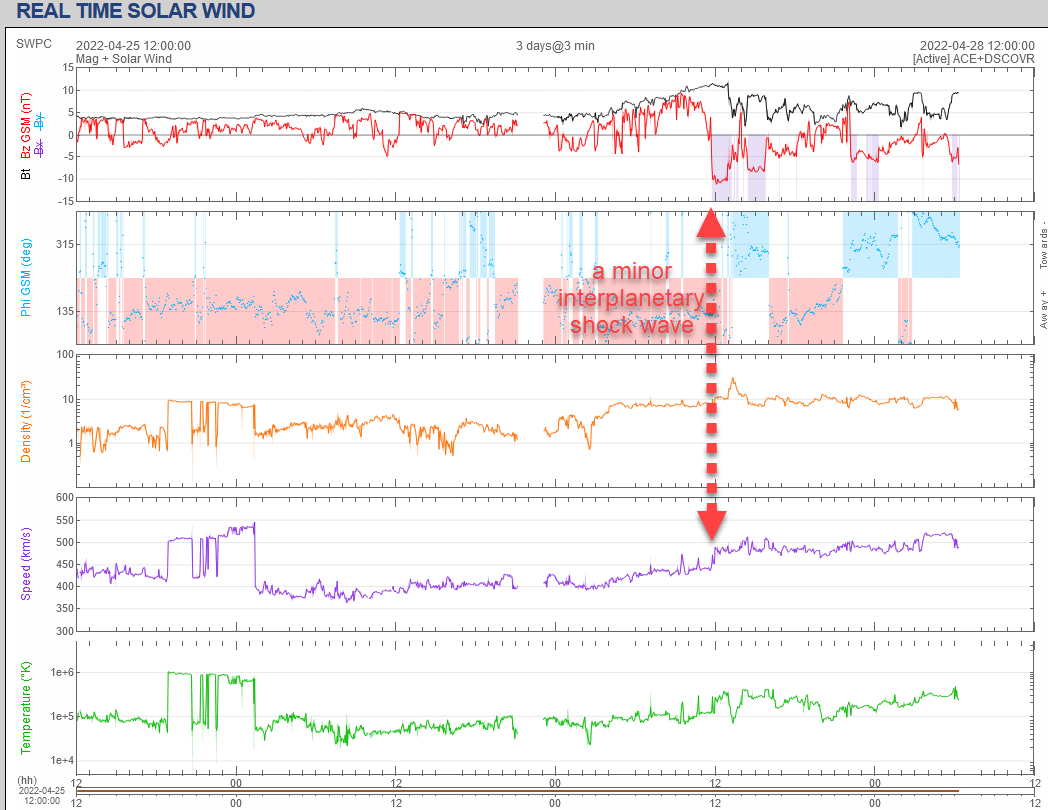
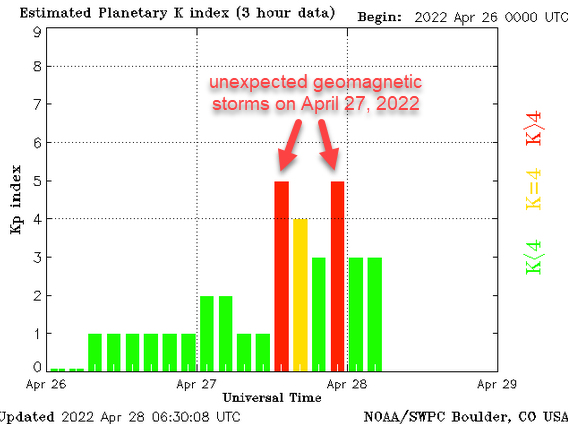
AFTERGLOW OF A GEOMAGNETIC STORM: An interplanetary shock wave hit Earth's magnetic field on April 27th. It wasn't a big one--just enough to spark an unexpected G1-class geomagnetic storm. Greg Ash photographed the afterglow from Duluth, Minnesota:
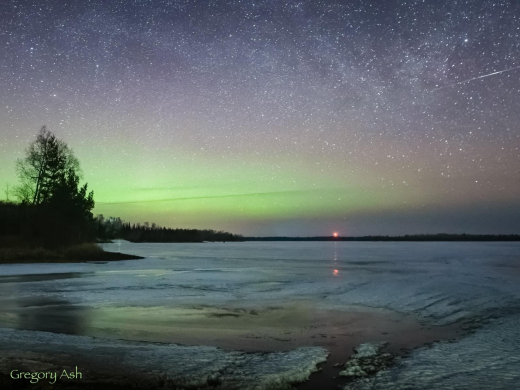
"It was really neat listening to the ice growl and shift while watching the auroras," says Ash. "A meteor streaked through the frame just as I was taking the picture."
The shock wave was probably a minor CME overlooked until it hit Earth. Right now the sun is crackling with solar flares, hurling multiple overlapping CMEs into space every day. A faint CME may have slipped through the net of NOAA analysts to deliver yesterday's surprise storm. This will happen increasingly often as Solar Cycle 25 intensifies.
Realtime Aurora Photo Gallery
Free: Spaceweather.com Newsletter
A NOCTILUCENT CLOUD OVER FLORIDA: Yesterday morning in Florida, Roger Menard went to the beach at sunrise to watch the Venus-Jupiter-Moon conjunction. "I also saw a noctilucent cloud (NLC)," he says. His cell phone captured the electric-blue cloud reaching toward the planetary trio:
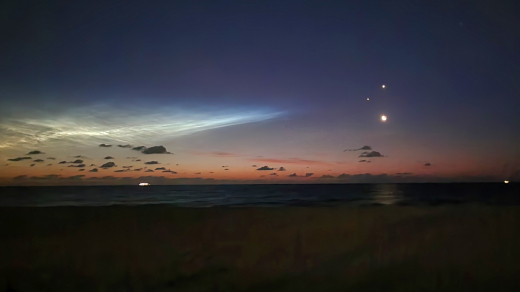
"It is quite unusual to see a noctilucent cloud from as far south as Florida," says Menard.
He's right. But this was no ordinary noctilucent cloud. It was a "rocket cloud." Less than an hour earlier, SpaceX launched a Falcon 9 rocket from the Kennedy Space Center carrying four astronauts to the International Space Station. Ice crystals in the rocket's exhaust caught rays of sunlight in the upper atmosphere, producing the unusual NLC.
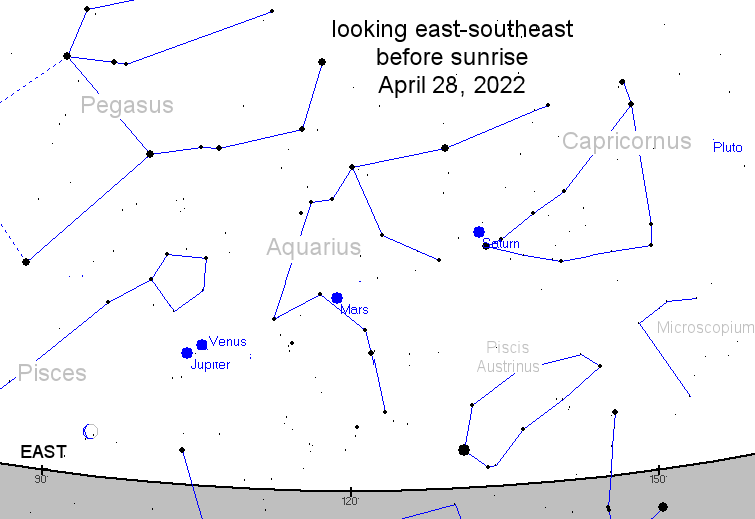
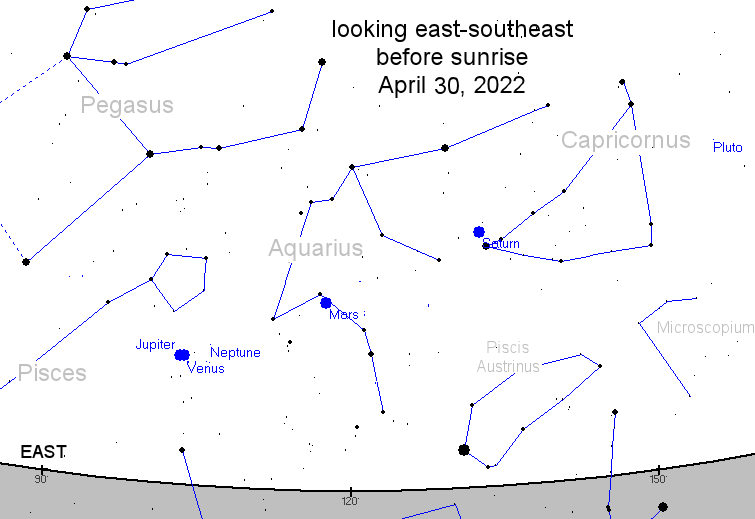
The noctilucent cloud is gone now, but the conjunction is still underway. Venus and Jupiter are converging for a close encounter on Saturday, April 30th. Set your alarm and enjoy the show. Sky maps: April 28, 29, 30, May 1.
Realtime Space Weather Photo Gallery
Free: Spaceweather.com Newsletter
MOTHER'S DAY IS MAY 8TH: Are you looking for an out-of-this world Mother's Day gift? Consider this: Every time the students of Earth to Sky Calculus launch a cosmic ray balloon, they include something extra in the payload--something Mom will love:

Every item in the Earth to Sky Store has flown to the edge of space and comes with a greeting card showing the item in flight. The interior of the card tells the story of the gift's journey from launch to landing. Mom-satisfaction guaranteed!
Mother's Day Special: Use coupon code "SPACEMOM" at checkout for a 10% discount. Offer valid from now until Mother's Day (May 8, 2022) .
Far Out Gifts: Earth to Sky Store
All sales support hands-on STEM education
| All Sky Fireball Network |
|
On Apr 27, 2022, the network reported 6 fireballs.
(5 sporadics, 1 beta Pegasid)

In this diagram of the inner solar system, all of the fireball orbits intersect at a single point--Earth. The orbits are color-coded by velocity, from slow (red) to fast (blue). [Larger image] [movies]
|
| Near Earth Asteroids |
|
|
|
| Asteroid | Date(UT) |
Miss Distance |
Velocity (km/s) |
Diameter (m) |
| 2022 GU3 | 2022-Apr-22 |
4.6 LD |
8.7 |
25 |
| 2017 UR2 | 2022-Apr-22 |
19.4 LD |
9.3 |
10 |
| 2022 HL1 | 2022-Apr-23 |
13.9 LD |
12.9 |
30 |
| 2022 HQ | 2022-Apr-23 |
8.7 LD |
7 |
13 |
| 2022 HD | 2022-Apr-24 |
3.7 LD |
7.4 |
13 |
| 2022 HH1 | 2022-Apr-24 |
7.2 LD |
5.2 |
11 |
| 2022 HA1 | 2022-Apr-24 |
17 LD |
8.8 |
42 |
| 2020 VN1 | 2022-Apr-25 |
19.3 LD |
2.3 |
9 |
| 2022 HB2 | 2022-Apr-25 |
2.2 LD |
8.1 |
13 |
| 2022 HK1 | 2022-Apr-25 |
4.4 LD |
5.7 |
7 |
| 2022 HS1 | 2022-Apr-25 |
4.4 LD |
5.8 |
12 |
| 2022 HB1 | 2022-Apr-26 |
0.5 LD |
14.1 |
12 |
| 418135 | 2022-Apr-28 |
8.5 LD |
10.4 |
466 |
| 2022 HX1 | 2022-Apr-30 |
6.5 LD |
11.8 |
15 |
| 2022 HS | 2022-May-01 |
6.7 LD |
5.7 |
20 |
| 2017 XO2 | 2022-May-01 |
18.8 LD |
12.4 |
125 |
| 2022 HA2 | 2022-May-02 |
12.1 LD |
12.9 |
38 |
| 2022 HW | 2022-May-02 |
16.1 LD |
16.1 |
47 |
| 2022 HW1 | 2022-May-03 |
9.9 LD |
7.7 |
20 |
| 2022 HR1 | 2022-May-03 |
5.1 LD |
13.3 |
23 |
| 2017 HG1 | 2022-May-04 |
18.2 LD |
6 |
11 |
| 2022 HF1 | 2022-May-08 |
8.8 LD |
17.1 |
62 |
| 467460 | 2022-May-09 |
14.9 LD |
11.3 |
513 |
| 2019 JE | 2022-May-11 |
4.9 LD |
7.2 |
20 |
| 2012 UX68 | 2022-May-15 |
2.8 LD |
8.2 |
54 |
| 388945 | 2022-May-15 |
15 LD |
8.2 |
290 |
| 2013 UX | 2022-May-17 |
16.8 LD |
16.3 |
141 |
| 2021 WY | 2022-May-18 |
16.9 LD |
9 |
65 |
| 2022 HD1 | 2022-May-20 |
15.3 LD |
6.8 |
60 |
| 7335 | 2022-May-27 |
10.5 LD |
13.1 |
1058 |
| 2021 KO2 | 2022-May-30 |
3.1 LD |
14.8 |
9 |
| 2020 DA4 | 2022-Jun-01 |
5.5 LD |
8.9 |
26 |
| 2021 GT2 | 2022-Jun-06 |
9.5 LD |
7.5 |
50 |
| 2018 LU2 | 2022-Jun-09 |
14.8 LD |
10.7 |
16 |
| 2006 XW4 | 2022-Jun-12 |
5.9 LD |
7.3 |
49 |
| 2022 GU6 | 2022-Jun-12 |
3.2 LD |
8.4 |
86 |
|
|
| Cosmic Rays in the Atmosphere |
|
SPACE WEATHER BALLOON DATA: Almost once a week, Spaceweather.com and the students of Earth to Sky Calculus fly space weather balloons to the stratosphere over California. These balloons are equipped with sensors that detect secondary cosmic rays, a form of radiation from space that can penetrate all the way down to Earth's surface. Our monitoring program has been underway without interruption for 7 years, resulting in a unique dataset of in situ atmospheric measurements.
Latest results (Nov. 2021): Our balloons have just measured a sudden drop in atmospheric radiation. It happened during the strong geomagnetic storms of Nov. 3-4, 2021. Here are the data:
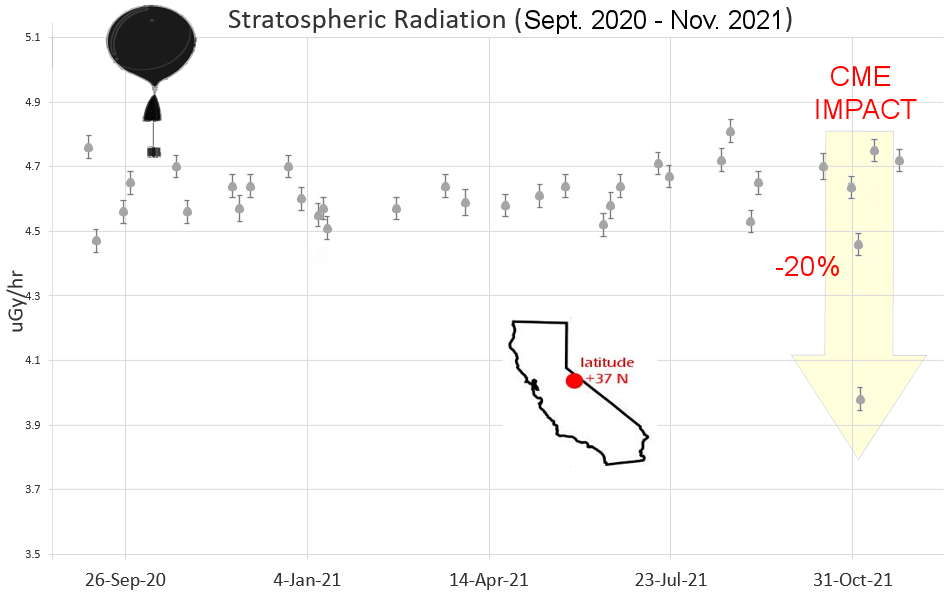
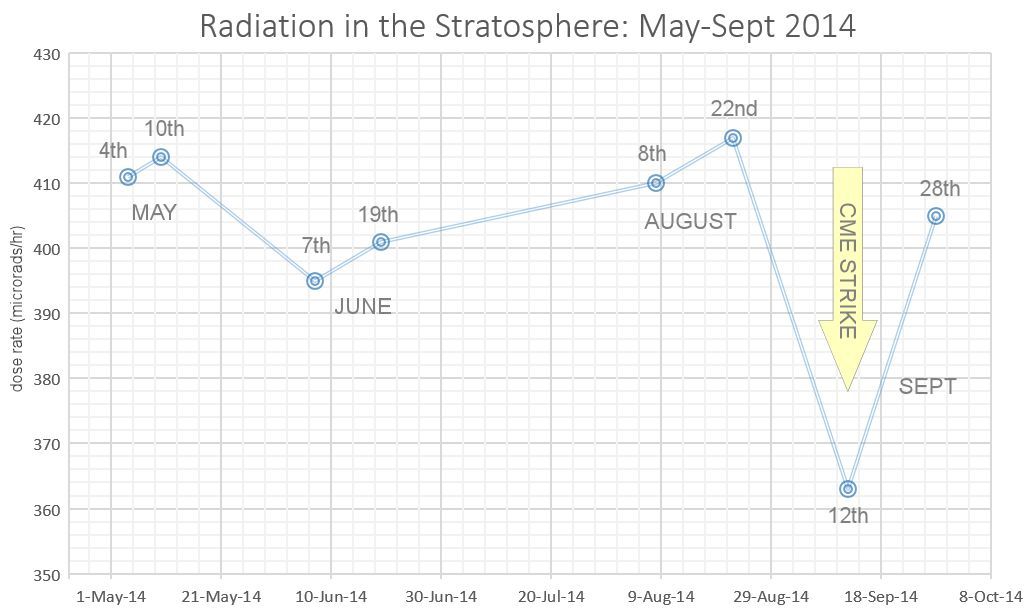
This is called a "Forbush decrease," named after American physicist Scott Forbush who studied cosmic rays in the early 20th century. It happens when a CME from the sun sweeps past Earth and literally pushes cosmic rays away from our planet. Radiation from deep space that would normally pepper Earth's upper atmosphere is briefly wiped out.
We have measured Forbush decreases before. For example, here's one from Sept. 2014. The Forbush Decrease of Nov. 3-4, 2021, was the deepest in the history of our 7-year atmospheric monitoring program. Radiation levels in the stratosphere over California dropped nearly 20%, more than doubling the previous record from our dataset.
En route to the stratosphere, our sensors also pass through aviation altitudes, so we can sample radiation where planes fly. This plot shows how the Forbush decrease was restricted to the stratosphere; it did not affect lower levels of the atmosphere:
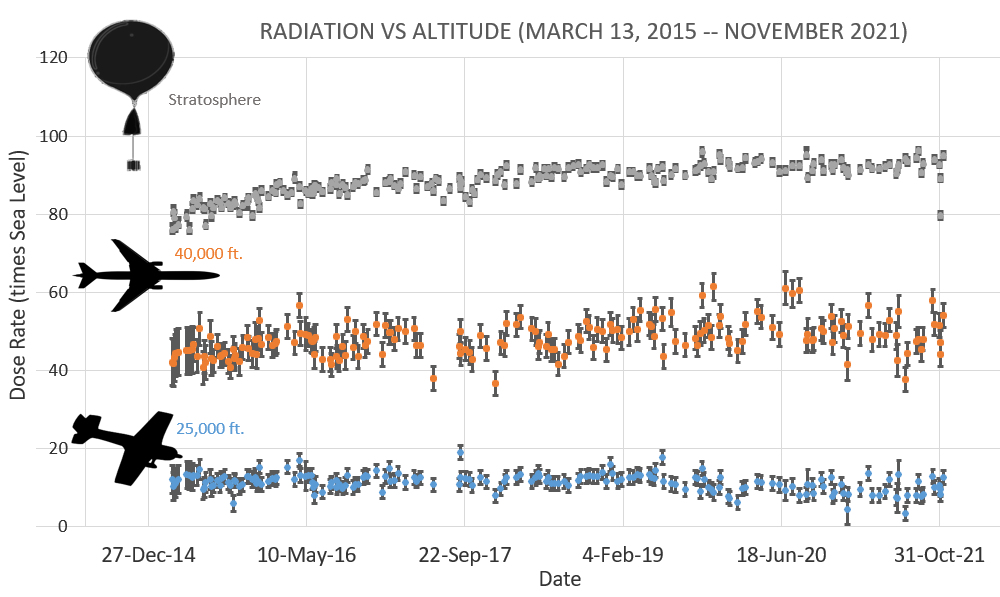
The dose rates shown above are expressed as multiples of sea level. For instance, we see that boarding a plane that flies at 25,000 feet exposes passengers to dose rates ~10x higher than sea level. At 40,000 feet, the multiplier is closer to 50x. The higher you fly, the more radiation you will absorb.
.Who cares? Cosmic rays are a surprisingly "down to Earth" form of space weather. They can seed clouds, trigger lightning, and penetrate commercial airplanes. According to a study from the Harvard T.H. Chan school of public health, crews of aircraft have higher rates of cancer than the general population. The researchers listed cosmic rays, irregular sleep habits, and chemical contaminants as leading risk factors. Somewhat more controversial studies (#1, #2, #3, #4) link cosmic rays with cardiac arrhythmias and sudden cardiac death.
.Technical notes: The radiation sensors onboard our helium balloons detect X-rays and gamma-rays in the energy range 10 keV to 20 MeV. These energies span the range of medical X-ray machines and airport security scanners.
Data points in the first graph ("Stratospheric Radiation") correspond to the peak of the Regener-Pfotzer maximum, which lies about 67,000 feet above central California. When cosmic rays crash into Earth's atmosphere, they produce a spray of secondary particles that is most intense at the entrance to the stratosphere. Physicists Eric Regener and Georg Pfotzer discovered the maximum using balloons in the 1930s and it is what we are measuring today.
|
| Essential web links |
|
 |
NOAA Space Weather Prediction Center |
|
| The official U.S. government space weather bureau |
|
|
Atmospheric Optics |
|
| The first place to look for information about sundogs, pillars, rainbows and related phenomena. |
|
|
Solar Dynamics Observatory |
|
| Researchers call it a "Hubble for the sun." SDO is the most advanced solar observatory ever. |
|
|
STEREO |
|
| 3D views of the sun from NASA's Solar and Terrestrial Relations Observatory |
|
|
Solar and Heliospheric Observatory |
|
| Realtime and archival images of the Sun from SOHO. |
|
SolarMonitor.org |
|
| information about sunspots based on the latest NOAA/USAF Active Region Summary |
|
|
Daily Sunspot Summaries |
|
| from the NOAA Space Environment Center |
|
|
NOAA 27-Day Space Weather Forecasts |
|
| fun to read, but should be taken with a grain of salt! Forecasts looking ahead more than a few days are often wrong. |
|
Aurora 30 min forecast |
|
| from the NOAA Space Environment Center |
|
Live Aurora Webcam |
|
| from Lights over Lapland |
|
Heliophysics |
|
| the underlying science of space weather |
|
To get the best views of the cosmos, check out the Phoenix Window Glass Replacement experts for all your window and glass needs |
|
|
If you are looking to name a star after someone, Dedicated Stars offers such service. |
|
|
Marketing on YouTube is essential so if you need to buy real organic YouTube views than RealSocialz.com should be your first choice. |
|
|
To get an up close view of the heavenly bodies surrounding Earth, think about selling your junk car for cash and buying a high quality telescope. |
|
|
Spaceweather.com welcomes these supporters of science communication: RV Sales and Arizona SEO and Arizona Business Directory and C8 Corvette | Phoenix Personal Injury Lawyer | Phoenix SEO |
|
|
Going above and beyond to provide the best homes listings in the Comox real estate market to keep you up to date and informed |
|
|
NASA Near Earth Asteroid Home Page |
|
|
BestCSGOGambling is the best site for everything related to CSGO gambling on the web |
|
To find reviews of new online casino sites in the UK try The Casino DB where there are hundreds of online casino reviews complete with bonuses and ratings. Alternatively, Online-Casinos.xyz is another massive directory of online casinos listing sites for the UK and Worldwide. Casinos that offer Rupees for bonuses are very generous to Indian players. Find the best online casinos in India at AllCasinos.in Looking for a new online casino? Try Casimpo the new site dedicated to making online casino simple, or check out the new Avenger Slots Casino and Ace Online Casino with over 500 online slots and casino games. |
|
|
One of the most popular casino games is the Book Of Dead Slot based on ancient Egyptian text, you can find all the casinos with spins at bookofdeadslotsites.com. |
|
|
When looking for casinos to play online when the weather is bad, you can try casino online trucchi for Italian games. If you are not from Finland you can try the Swedish page Svenska casino online to find suitable games, check out svenskacasinoonline.net. Always check your local laws before playing with real money. |
|
|
Chicago SEO Expert |
|
Search Kelowna Real Estate Listings & Homes for Sale easily. Find help on all Calgary Homes For Sale and Real Estate Listings. Great source for Edmonton Real Estate Listings & Homes For Sale |
|
|
Looking for sports betting companies not registered on GamStop? CasinoGap has presented a list of sites not on GamStop available for UK players. Check and bet online! Would you like to bet at sites not using GamStop? Look at a list of NonStopCasino sites for online betting that aren't on GamStop. Top-rated bookmakers ever! |
|
| These links help Spaceweather.com stay online. Thank you to our supporters! |
|
| more links... |

|
An unexpected geomagnetic storm today as the Bz component of the
interplanetary magnetic field (IMF) decided to tip south. Minor (G1)
conditions observed at 14:02 UTC. High latitude sky watchers should be
alert for aurora once it is dark outside.
|


|
How many coronal mass ejections have been observed over the past 3 days? Well... the answer is in the video below. It appears that most of these plasma eruptions are farsided or off the limbs and not directed towards Earth. Sooner or later, we will be in the path. For now we wait. Composite video by LASCO C2/C3.
|





Comments
Post a Comment
please follow, like and comment