
Sun activity: X-flare! BAM!
Sun activity: X-flare! BAM!

March 30: X-flare!
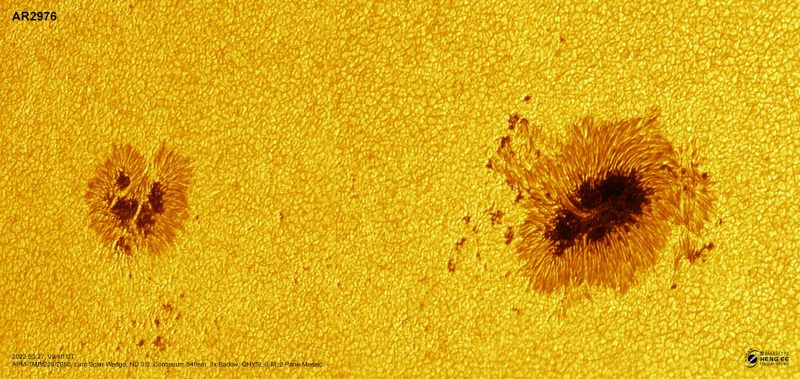
Sunspot AR2975 blasted out an X1.38 flare just now (at 17:37 UTC on March 30, 2022). It created an R3 level radio blackout over the Americas. For those who don’t know, heliophysicists use a classification system that divides solar flares according to their strength. The smallest ones are A-class, followed by B, C, M … and finally X. So X-flares are the strongest solar flares.
The source of the March 30 X-flare – sunspot AR2975 – has already sent at least two coronal mass ejections (CMEs) toward Earth this week (see below).
Generally speaking, if X-flares are Earth-directed, they and their associated CMEs can create strong geomagnetic storms that can harm satellites in Earth orbit, communications systems, and power grids. It’s too early to tell whether the March 30 X-flare from AR2975 also sent a CME toward Earth. But we do know that NOAA reported a type II radio burst that is associated with shock waves in the sun’s corona as well as CMEs.
We’ll let you know when we hear more.

Earlier on March 30: Geomagnetic storm watch
Activity on the sun earlier this week prompted NOAA to issue a watch for a strong geomagnetic storm. NOAA is now projecting strong storms with a G-3 classification. That means we might get auroras as far south as Illinois, New York and Oregon. Updated watch times suggest the “cannibal CME” from two combined storms will strike at 0 UTC on Thursday, March 31. That is 7 p.m. CDT on Wednesday, March 30, for us in the Americas.
Aurora alert!
Today’s sun

March 29: NOAA models show ‘cannibal’ CME
NOAA computer modeling suggests that the two CMEs headed for Earth – from the high level of activity on the sun earlier this week – will combine, creating what is called a cannibal CME (one CME “eats” the other). The cannibal CME is expected to strike Earth’s magnetic field around 3 UTC on March 31 (10 p.m. CDT on March 30).
March 28: M-flares and C-flares
Active sun! Sunspot AR2975 produced multiple M-class flares on March 28, 2022. The same sunspot also produced severals C-class flare that verged on M status, at C9.8.
The biggest M-flare came earlier in the day, at 11:30 UTC. The solar flare peaked at M4.1. This eruption produced an R1 level shortwave radio blackout over Africa. NOAA reported a burst of radio waves indicating a possible fast CME. There is also a sudden increase in solar protons. The protons reached the level of an S1 proton storm alert from NOAA. While the flare created a radio blackout at the peak of the flare, the proton event creates a delayed radio blackout over Earth’s poles. The event also produced a solar tsunami (EIT wave). Stay tuned for more updates on how this will affect Earth.

Recent sun and aurora images from EarthSky’s community



Bottom line: Sunspot AR2975 blasted out an X1.38 flare at 17:37 UTC on March 30, 2022. It created an R3 level radio blackout over the Americas. Too early to tell if there’s an associated CME, which has the potential to harm power grids and satellites in Earth orbit.


Comments
Post a Comment
please follow, like and comment