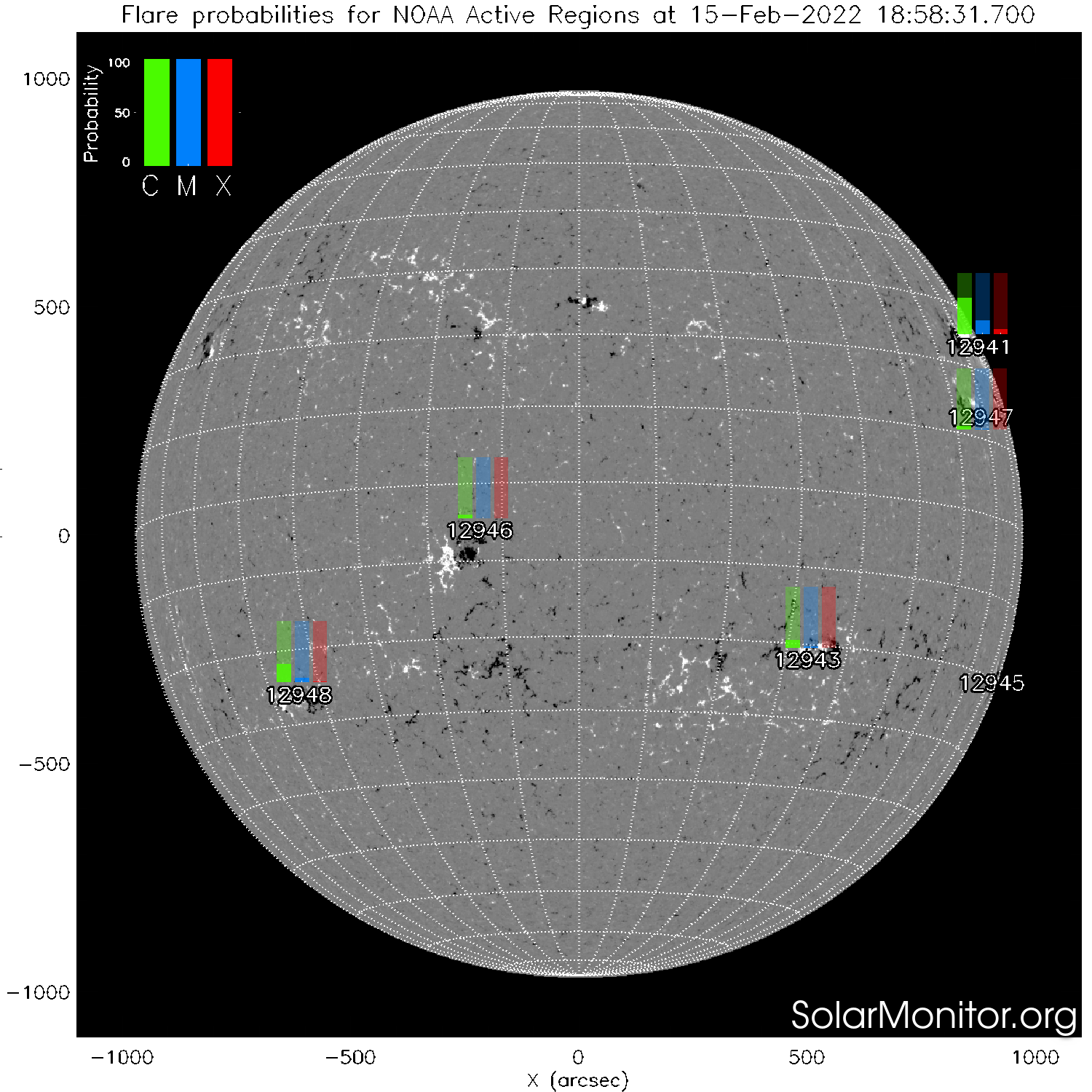
NOAA NumberMcIntosh ClassC-classM-classX-class

12941
12946
12947
12948
12945

Eki/Fki
Cro/
Hsx/Cso
Bxo/---
Dso/---
MCEVOL
MCSTAT
NOAA
608160
655
...65
...3020
......5
MCEVOL
MCSTAT
NOAA
234220
031
...11
...75
......1
MCEVOL
MCSTAT
NOAA
871
001
...01
...11
......1

Solar Monitor's flare prediction system's probabilities are calculated using NOAA Space Weather Prediction Center data. There are two main methods, MCSTAT and MCEVOL, that use sunspot-group McIntosh classifications and Poisson statistics to calculate flaring probabilities valid for a 24-hr period*. The flaring probabilities are calculated using historical data from the periods 1969-1976 & 1988-1996 (MCSTAT) and 1988-2008 (MCEVOL).

MCSTAT – Uses point-in-time McIntosh classifications to calculate Poisson flaring probabilities. Details about the method [1] and forecast verification testing [2] can be found in the following papers:

[1] Gallagher, P. T., Moon, Y.-J., Wang, H., Solar Physics, 209, 171, (2002)
[2] Bloomfield et al., 2012, The Astrophysical Journal Letters, 747, L41

MCEVOL – Uses the evolution of McIntosh classifications over a 24-hr period to calculate Poisson flaring probabilities. Details about the method and flaring rate statistics can be found in the following:

[1] McCloskey, A.E., Gallagher, P.T. & Bloomfield, D.S., Solar Physics, 291, 1711, (2016)

Further Reading:
Wheatland, M. S., 2001, Solar Physics, 203, 87
Moon et al., 2001, Journal of Geophysical Research-Space Physics, 106(A12) 29951


Notes:

'...' = McIntosh class or evolution was not observed in the period over which the Poisson flare rate statistics were determined.
* When viewed in real-time and before 22:00 UT, NOAA predictions are valid up to 22:00 UT on the current date. When viewed in real-time after 22:00 UT (or when viewing past dates), NOAA predictions are valid up to 22:00 UT on the following date. The most recent data can also be found at NOAA's 3-day Space Weather Predictions page.


Please contact Peter Gallagher if you have any queries regarding this research.


GOES
ACE
SDO/EVE
Events


Today's/Yesterday's NOAA Active Regions
NOAA Number
Latest
Position
Hale
Class
McIntosh Class
Sunspot Area
[millionths]
Number of Spots
Recent
Flares
12941N23W80
(880",395")
βγ/βγEki/Fki0320/033010/11-
12943S23W35
(514",-290")
β/Cro/0030/04/-
12946S07E12
(-201",-4")
α/βHsx/Cso0060/009002/08-
12947N12W69
(887",241")
β/-Bxo/---0040/----03/---
12948S27E44
(-602",-364")
β/-Dso/---0080/----03/---
12945S21W88
(906",-341")
/β/Bxo/0020/04-

Class (HH:MM) -Today
Class (HH:MM) -Yesterday

Events not associated with currently named NOAA regions: C4.7(05:12) C1.0(14:19) M1.3(17:54) C1.6(13:41) C5.0(14:01) M1.0(17:02)

Note: The tabulated data are based on the most recent NOAA/USAF Active Region Summary issued on 15-Feb-2022 00:30 UT . The greyed out and light-blue entries are values from the previous day. Slashed cells indicate that the active region has no spots. The latest positions of the active regions are given in both heliographic and heliocentric co-ordinates. The region positions are valid on 15-Feb-2022 20:30 UT .

Comments

Popular posts from this blog

The Philadelphia Experiment – What’s the Real Story?

The Pentagon Just Confirmed the First-Ever Interstellar Visitor to Earth

A rocket part could collide with the moon in the next few weeks